Thursday, 5 September 2013

Aug update

Aug update

indexed NAV
adjusted return
100.00
Nov-12 17.8% 117.77
Dec-13 37.4% 161.78
Jan-13 38.1% 223.40
Feb-13 -3.3% 215.92
Mar-13 12.4% 242.62
Apr-13 30.2% 315.81
May-13 68.8% 533.08
Jun-13 36.9% 729.55
Jul-13 -12.6% 637.46
Aug-13 -1.7% 626.31


Another frustrating month, especially in FX where I insisted on selling lows and buying highs again, but things seem to be picking up into September.

Ideas I like at the moment :

1. Long GBPCHF

People are getting used to the the idea that the eurozone isn't going to collapse (yet), but EURCHF is still at historically expensive levels. As CHF will lose more of its safe haven premium it makes it an attractive short against GBP. Obviously there's no net negative carry to speak of, and the chart looks good, as we're breaking out of a 3 or 4 year downtrend. The 1.40 level is good support provided eurozone breakup is off the table :


It's really a doubly leveraged trade on eurozone recovery, as this is also one of the main reasons for the weakness of the UK economy since 2009. I prefer buying GBP to selling short sterling or gilts as the positioning seems cleaner and I don't want to incur the negative carry in the yield curve.


2. Resumption of the Abenomics trade

Japan still has some of the cheapest equities in the world, especially the megabanks. With very little fuss they offloaded a huge proportion of their JGBs on to the BoJ last quarter (almost half of them in the case of Sumitomo), and they're still on very cheap price/book ratios (0.75 for MUFG) and low p/es around 8-10. Just cheap then. Kuroda's commitment to further easing if the consumption tax slows the economy is important in underwriting the recovery, and USDJPY should be forced higher by rising US yields.


3. Aussie rates

The RBA may be taking a pause or done altogether, but either way the bill curve looks too steep. It's pricing 58bp between Z3 and Z4, and with all the PMIs in recession, retail sales growth stuck at zero and unemployment rising towards its 2009 peak that looks plain wrong. There are plenty of secondary reasons (mining capex cliff kicking in next year, some degree of fiscal restraint from the new govt and poor business confidence, eg the NAB survey). Further cuts next year aren't out of the question, but even without that this is my favourite slowdown trade. It's fighting the US rates headwind, but that's the reason for doing Z3/Z4 flatteners rather than just buying 3yr futures outright. It rolls down from 58bp in Dec to 31bp in Sep.


4. US yields

Last but not least, a Sept taper looks unavoidable now. The interesting question is, what next ? They've stuck so far to Bernanke's timetable (start tapering in Sept, finish by mid-2014), but the domestic data is turning out better than they expected, and the global data is far better. If anything that should bring the mid-2014 end date closer (and please don't suggest that Summers will stick to the schedule because he inherited it).*IF* they start with $10b in Sept, and pause in Oct to see the effects, then they have $75b to remove in at most 5 meetings. Alternatively they could start with $15b or $20b in Sept, or taper again in Oct. Any way you look at it, it's a more aggressive schedule than most people have been discussing, so it seems to me that when the market starts thinking about this on Sept 19th we'll have to sell off some more. Favourite trades here are short EDZ7 (still), covered puts in TYZ3 and FV/WN flatteners, ie 5/30s. And short some gold, just because it's had such a ridiculous squeeze.




Thursday, 8 August 2013

July update

July was frustrating : after getting payrolls right and seeing a fresh high water mark, I was too slow to reduce in the face of the Fed's jawboning. As usual, when you start trying to defend P&L I ended up buying highs and selling lows, until I got fed up with my own wrong-headedness and cut properly just after mid month. Net-net, July ended up with a 12.6% loss, split between the following areas :

Equities
   UK               -0.9%
   Japan            -0.6%
   US                -1.2%
Fixed income
   US                -6.8%
   UK               -0.5%
Commodities
   Gold             +0.4%
   Copper          -1.8%
FX                   -1.3%

The driver has been US fixed income, not surprisingly. The data has been extremely strong in my opinion, payrolls notwithstanding. Rates did actually move marginally higher over the month, which makes a loss in this area even more inexcusable. New month resolutions :
- don't spend money on option premium
- run smaller positions
- don't trade reactively
Remaining positions are short AUD against USD and NZD, despite it being a very consensus trade, short EDZ7 and TYU3 and short gold again, all in less than half the size of late June.

All basic stuff. The most frustrating part is that if I'd had the discipline to do absolutely nothing at all I'd have made money in July. Time for a refresher course in trading discipline.

Wednesday, 3 July 2013

Will Jun payrolls be the straw that breaks the bull market's back ?

We're on the verge of breaking a rather serious trend. This is the 10yr yield since 1980 (the secular bull market in fixed income, older than half the people currently trading it). If 2.50 goes, then watch out. Will Jun payrolls be the straw that breaks the bull market's back  ? 


After good-to-strong recent data (ADP, car sales, durable goods), and a 25bp rally in 10s to flush out the uncommitted shorts, the pieces could be in place for a move to new yield highs. The obvious near-term target is 3%, about the same 150bp selloff that we had in Jun 2003 when the market realised that the last cut had arrived and the next move in rates would be higher. 10y notes have sold off 50bp due to the FOMC (2.16 to 2.66), and retraced 25 to 2.41. A second 50bp selloff from 2.41 would get to 2.91. Presumably that needs a strong payrolls number, which might be what the strength in consumer confidence and spending is saying. *If* we get to 3% then the above chart suggests we're in very scary territory. 


Here's a slightly biased perspective on current data :

5 yr highs                                                                               5 yr lows

Consumer confidence
Michigan, Bloomberg, Gallup, Conference Board

Housing market
NAHB index, permits, new home sales, Case-Shiller,
     S&P Comp-20 YoY change, existing home sales

Labour market
JOLTS job openings 3mma                                                   Jobless claims 4wma, unemployment rate
Gallup job creation index

Misc
Vehicle sales, NFIB optimism

and just for the record :
Fed balance sheet                                                                   Fed Funds rate 


What weakness there is comes from China, the Gulf, perhaps the Eurozone, and lagged effects of the sequester. I'm only really concerned about the first two.

The point is that broad swathes of the US economy, covering housing, consumer confidence & spending intentions, the labour market and business confidence, are recovering strongly, while monetary stimulus remains at full throttle. The Fed have stepped away from the controls and are claiming they won't come back before 2015. Fixed income had a wake up call last month, but 10s at 2.50 aren't cheap : how many investors who were bullish or confidently sitting on carry trades two weeks ago have had time to adjust to a bearish mindset ? Usually the shock of a loss takes longer than a fortnight to heal, so I think the path of least resistance is towards higher yields as people re-position themselves for a tightening Fed.
The "brave" trade here is to maintain a short into payrolls : buy short dated put spreads on TY and US and buy back the lower strikes of any longer dated put spreads in the hope of re-establishing them at much better levels. Actually it's not really that brave - the risk/reward based on the chart above makes the short trade the easy one. The scary trade here is to be long.


Sunday, 30 June 2013

June update


    Month    Mthly return       NAV

15Nov12100.00
Nov-1217.8%117.77
Dec-1337.4%161.78
Jan-1338.1%223.40
Feb-13-3.3%215.92
Mar-1312.4%242.62
Apr-1330.2%315.81
May-1368.8%533.08
Jun-1336.9%729.55


Overall view
The Fed is sticking to its party line : no hikes till 2015, but tapering in September, data permitting. After Stein's speech that sounds disingenuous. They're going to base the tapering "decision" on the accumulated data since QE3 started, and they're de-emphasizing individual payroll releases. That suggests that the decision has already been made, well before they went public a few weeks ago (hardly surprising given the stakes involved). It raises the question of whether Bernanke has lost the backing of the FOMC for QE3. Perhaps the leadership is still in favour, but the troops are rebelling. Lame duck or not, it's a Treasury bear market, and with more tapers in the pipeline and QE3 ending next year, the long end is a sell on rallies at least until Sept. Foreign central banks have got the message and are already selling in size. We've had a huge move though, so probably it gets harder to trade from here.

An interesting question is this : how different is this recovery from "normal" ? Usually rate sensitive sectors like housing and auto sales lead the recovery (tick), followed by increasing corporate investment (tentative tick), and a precautionary buildup in inventories, then falling unemployment (another tick) before finally consumption picks up the baton. The Fed would start hiking a year or so after the recovery started, once falling unemployment was well-entrenched. Aren't we there already ? If so, then 2015 is a wildly optimistic estimate for the first hike. 18 months from today. Really ? Ok, so GDP growth rates are well below normal, but you wouldn't know it if you looked at the unemployment chart. Anyway, GDP stats are notoriously prone to revision. 
Even worse is the Fed's inability to restrain the credit cycle. Normally commercial banks don't hold meaningful excess reserves at the Fed, so the Fed can easily curb excess credit growth, either by hiking rates or raising reserve requirements. To do that now, they need first to reverse much of the cumulative QE (all 3 rounds of it), as until then the banks will have excess reserves which they can lend freely if the demand is there. Or they could raise IOER out of the blue (the 1994 scenario). The Fed have checkmated themselves, just as the economy starts getting traction. They might turn out to be well behind the curve by the end of this year. Of course Bernanke won't be around to deal with the problem. In their shoes I'd be quietly praying for a Chinese hard landing to get me off the hook. The risk premium in the 2016-2018 part of the ED curve could go through the roof in this scenario.

The short trade in treasuries works if US real rates keep rising. The threats come mainly from China, which I've covered by shorting AUDUSD and copper. If the Fed miraculously turn dovish for some other reason then equities should explode higher, and I think that's best covered by a Nikkei long (which is now purged of excess positions I think, and which should work even in a treasury bear market provided usdjpy resumes its climb). My favourite equity market is Japan as explained, and I have a small short in SPX. Nothing in FTSE for now, though I'd buy it rather than selling it here.

Specific trades.
Gold : I've closed my remaining gold short on this collapse, and will wait for a rally to re-establish. I could envisage a stand-up fight between bulls and bears somewhere between 1000 and 750, where we decide who's right. In essence, should gold be at 200 or 2000 ? Until then the primary direction is lower, but we're well oversold so I'm on the sidelines for now. Gold made up 20% of June's performance.

Japan : I can't see usdjpy going down and staying there, with the Fed tightening and the BoJ easing. Now that spec positions have been purged (did they clear the decks for half year end ?), the path back through 100 seems open, and the Nikkei is a buy. This is probably my favourite reflation trade in the current environment. Japanese retail have few other options as inflation rises, and the quasi-govt institutions are being herded into equities by the bureaucracy.

Treasuries : Still a bear market in the long end, although the short end will be supported by Fed rhetoric (until it isn't !). After the FOMC I covered some of my outright short by buying covered calls in EDZ4, selling short Dec 99.375 calls for 10ish bps versus futures, against bearish positions in TY and US. Half of this month's return was US fixed income, so I've taken some profit on EDU4/U5 too. 

Copper : short, looking for a break of 3.00 in HG1. This is another expression of the short AUD trade, but without negative carry and more focussed on china. Flat this month.

Australia : still short, and just trading around the core position by buying a little back on really bad days. A third of June's return was Aussie.


If the easy moves are over, then having a plan and staying disciplined is going to be even more important than usual. Easy to say, not so easy to do.

Friday, 21 June 2013

Dammit Jon, those Dec14 euros are 20bps too low, I tell you. Talk them up, there's a good chap !

The selloff in treasuries is on the brink of becoming self-propelled - classic VaR shock stuff. The Fed is trying to micro-manage the short end with these Hilsenrath articles. Volcker and even Greenspan must be quietly seething as they watch this farce, but the attempt to stop rate hikes being priced in only underlines the message that tapering is on the way. Steepeners are the path of least resistance : I like EDZ4/Z7 more than U4/U5 at these levels, but it does suggest selling 10s and bonds against red EDs. Pimco etc are long and wrong here, and clearly aren't out yet, so rallies in the long end are to be sold. 2.5% for 10y yields is too good a risk/reward balance to be sustainable (should be about 20bp higher I'd say). Everything will presumably rally out of sight on Monday after Hilsenrath's pronouncements, so maybe next week will be the window of opportunity to sell the long end before payrolls the week after. The real threat to tapering comes from an equity collapse, so I'm short SPX now.

Copper is increasingly interesting. LME stockpiles are at a 10 year high, and supply - expected demand is projected to triple this year from last. That can only get worse if China's landing turns out to be as hard as it's looking. Why would the new regime back off now ? They have one opportunity only to squeeze some excess from the system and blame it on their predecessors, and that isn't a 2 week process. There'll be false glimmers of optimism along the way, but it seems to me we're into a multi-month tightening in China. With high inventories, prices sitting on a multi-month support level and a hawkish Fed, copper should be set for a break lower. Short now, with a view to selling more if we drop through 3.00.

I've pulled out of Japan entirely (took profit on usdjpy longs and a small long in nikkei), but on reflection maybe usdjpy is still worthwhile, with the two central banks heading in opposite directions. I'll avoid the Nikkei as I don't think this is an equity friendly backdrop.  I'm flat in GBP and the eurozone, but keeping the short audusd trade, and reducing my gold short. It's dangerous to have too many moving parts when it's this volatile.

Thursday, 20 June 2013

copper

First thing to admit is that I know nothing about copper per se...

However, the Chinese shibor squeeze seems to be serious, and apart from selling audusd, which I already have on, copper seems the perfect trade. Add a hawkish Fed, and a chart that reminds me of gold in the way that it's been more-or-less supported at 300 for a few years (like the 1530 level in gold) and the risk return looks promising. It's not as clear as gold, where there were massive retail positions and inflation was falling rather than rising, but the degree of consensus about Chinese growth is not dissimilar to the way people spoke about gold a few months ago. It doesn't seem a crowded trade (no-one's mentioned it to me at any rate), so I think it can have a clearout here. Target 2.50 perhaps ?

A bit more homework is needed before making it a "proper" position, but I'm shorting a little bit here. Sell HGU3.

Friday, 7 June 2013

Back to the Old Normal ?


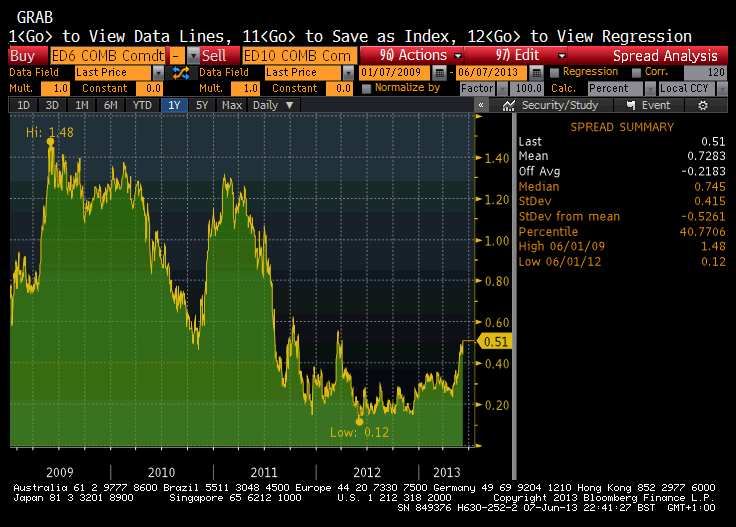
A very ugly close, for a payrolls number which shouldn't have been that bad for fixed income. Look at the rolling 6th vs 10th contract (ie EDU4/U5) back to early 2009 :


Where we are now - about 50bp - was the floor until mid-2011, since when it has been the ceiling. (Incidentally you get the same picture, with the same dates, if you look at 10y yields or 30y yields - we're talking about the entire treasury market here, not just one obscure spread). I think that until mid-2011 most people believed we were still operating in the Old Normal, and the US would get a standard recovery (remember all that U/V/L debate ?). If you suggested that the US was in a Japanese style slump (L-shaped), people laughed at you. After mid-2011, with the extended period commitment for zero rates, Op Twist and open-ended QE3, L-shaped has become conventional wisdom, and the world has invested accordingly.

So *if* the labour market, retail sales and private capex hold up in the face of the sequester etc, then it seems that we're crossing from the New Normal (L) back into the Old Normal (U or even V). In that case this spread ought to head towards 100bps - which funnily enough is where the front calendar spread traded in Japan as they exited ZIRP in 2006. Hilsenrath's article today suggests that the Fed is going to taper in Sep or Dec, and the market will extrapolate that into rate hikes a year later.

We're basically at the cusp between two entirely different views of the world, and so vol will go through the roof. A couple more decent US numbers and they'll be throwing in the towels thick and fast.